 Project Hail Mary
I was reading the first part of Project Hail Mary and thought, man Weir sure likes his isolated man against an alien environment. In the Martian, Mark Watney, the biologist, is left alone on Mars and has to fend for himself (he uses his crew mate’s poop to grow things). However this book has moments of isolation but it’s the “bromance” of the year.
Isolation (no poop this time) plays into, Project Hail Mary. Dr Ryland Grace wakes from a coma, alone and spinning through space unsure where or why he’s in space. Then the unexpected happens. Grace finds his BFF and they become two dudes in outer space learning how to communicate.
Along with the present time narration, the past feeds into the why (dude spinning alone in space does not make interesting reading or movie plot). One reason Dr. Grace is in space is because he’s the leading expert on Astrophange, a microorganism causing the sun to lose brightness and in twenty-five years, the sun will dim enough to create a planet ending catastrophe. Funny enough the exact opposite of global warming. Here we go again say the dinosaurs.
 A Gentleman in Moscow
The novel follows the life of Count Alexander Rostov, a dying ember of the Russian aristocracy, soon to be totally extinguished by the Soviet empire. He commits a crime and is forever banished to the hotel. He becomes a “non-person” and is told that if he ever leaves the hotel he will be “shot.” He is a man of culture enjoying good food, wine, music and books – a complete antithesis to the bland, boring and bureaucratic Soviets. He is lucky. Many of his countrymen did not get confined to a luxury hotel; rather they were sent to gulags in Siberia.
The setting is what first drew me into the book. The old hotel with all it’s secret rooms and doors very few humans have passed through is magical. You can smell the dust in the old carpets. The Count follows his young friend Nina who gets a set of keys that open every door in the hotel. Can you imagine, a pass to go anywhere in an old hotel? I worked in a very old hotel that was built in 1915. And it was very spooky. I went into the basement once and let me say, it was a very short visit.
With the Count we travel along Russian history through Lenin, Stalin and finally Khrushchev. Surprisingly the author doesn’t deal with the second world war with the Nazis knocking on Moscow doors (probably a novel in itself). The gulag period under the Stalin is dealt with in the most traumatic fashion. His young friend leaves the Count a gift, a gem she never returns to reclaim. We also see the strong arm of Soviet propaganda and the results if you don’t follow for example removing information from prominent Russian writers so they conform with the new regime.
 The Road
And if the publishing industry wasn’t horrible enough, the other book on my night table is “The Road” by Cormac McCarthy. I’ve read many of his works and if one idea threads through his work, it’s the belief humans are horrible, blood thirsty creatures (see above article). If destructive social media isn’t bad enough, how about storing people in a basement so you can eat them later. Or is there a relationship here? Isn’t this what the internet is all about – eating people alive.
The dystopian novel takes place after some horrible catastrophe. A boy and his father are travelling across a landscape filled with ash and destruction. All life destroyed except for a few dogs and travelling bands of nasty people who are ready to kill, steal or eat you. The pair are attempting to make their way to the coast where it’s warm and hope possibly lives.
The dad is dying and the boy was born into this decaying world. He knows about birds, but he’s never seen one. The journey leaves you feeling cold and damp. They camp, eat food from tins when they can, pull a shopping card filled with their few life possessions (I love the mirror on the cart – not a bad idea for all shopping malls). Not a happy novel, but one that makes harsh comments on the nature of society and where we are heading.
Even though hope runs through the novel – the boy is hope. The major question is, who wants to live in a world where we are afraid to help people and human creatures are ready to devour us? Why are we so horrible to one another?
Ok, I gotta go and plant a tree or hang a decoration on one.
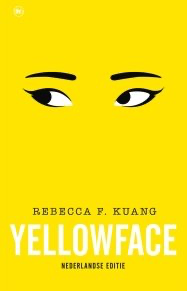 Yellowface
Right now, I am reading two novels. The first is “Yellowface” by Rebecca Kuang. Holy shit. My first reaction is I will never publish a book on the traditional road. What a nasty, horrible process. How does one keep their sanity? As a theme in the book, it’s not always possible. If I were ever to publish, it will be self-published. I will be my own team. I never want to go through all that shit. What a horror story.
And social media, my goodness, the novel makes we want to delete all my socials (again). Professional online people are packs of blood thirsty animals dedicated to destroying the lives of others. Who would want to deal with that crap? How do these predators wake up and look in the mirror every morning.
Ethnic quotas? Only one Asian story a year, please. And do not criticize the white authors, so says the right wing cancel culture groups. Holy limiting Batman. So much for writing about whomever and whatever. However, I find it ironic that an Asian girl is writing about a white girl who stole a book from an Asian girl. But that’s the point, right? It gets across very well.
I know the book is a satire, but at one point we find out for many authors themain reason for writing is immortality? Are you serious? The need to live forever through your art. A lasting impression should be through the people you love not through some nasty assholes on the internet. Is this where we are as a society?
A great eye-opener. A shocking read. However, whenever I feel the need to publish, I’m going to pull out this book – motivation indeed. Thank goodness Faulkner or Woolf or any early twentieth century writer were never around to experience this mess. Or maybe they were, but we never heard about it.
 Thursday Murder Club
Yes, I’ve started a new book. The mystery never ends. The novel is the first in a very successful mystery series by Richard Osman (four at last count). The stories revolve around a group of grey-haired sleuths who live in a retirement home in Kent, England. I mean what else do you do when you retire? Screw knitting, right?
In this novel, a dude is murdered in his home, smacked over the head with a blunt object. Beside the dead body is a picture of two other dudes with a ton of cash surrounding them. How did the picture get there? And who took it?
A group of seniors are on the prowl, lead by Elizabeth with her suspicious police and
government connections. She also clandestinely worked outside the Isles in her past. Holy MI-5 or 6 Batman (we are not totally sure which agency – as any good spy would nurture). Next is Joyce, a kindly old chatter box. She worked as a nurse, previously. We have journal entries from her, exposing information about the murders but also her very humorous naivety in contemporary issues; for example the surprise when she finds out you can send photos on your phone. We also have Ibrahim, the psychologist and Ron, an ex-union thug to round out the club. A very interesting and diverse group.
 Then She Was Gone
I just finished “Then She Was Gone” by Lisa Jewell. I don’t know how to categorize the book – mystery? Thriller? Whatever the genre, I enjoyed the read, but holy darkness, Batman. We’re talking Chris Nolan cape crusader. Not for this review, but why is everything so dark these days – books, movies. What does this say about our society?
The novel is about the Mack family living a very common existence in North London, dinner parties, good grades, high school romance. Until a horror beyond horror hits the family. The family’s golden child, Ellie, is snatched. She’s gone. The action rips the family apart, creating weird broken relationships. The parents, Laurel and Paul, split up because Ellie’s mother devotes all her time to finding her favourite child. She gives up on the living family.
 Redhead by the Side of the Road
When I read this book I kept thinking, “Hey this is me.” I like to run and I don’t wear glasses for the same reason as Micah Mortimer the protagonist in the novel does (don’t wanna look old). I also love to drink beer in the evening (although I upgrade from Bud) while playing video games. Well, yeah.
I also love tech, but not to the point where I have a business setting up printers for seniors or trying to unlock passwords from a young woman whose grandmother left her everything except the key to her computer. He doesn’t even realize she’s flirting with him – stone cold out of reality. And so the similarities end. Although I might be just as clueless in this instance.
I was moving along syncing with Micah until life unravels for our tech runner. His girlfriend leaves him because he makes a choice that doesn’t include her. His past girlfriend’s son shows up and the possibility that he may have offspring doesn’t even faze this guy. I’d be seriously engaged in this past possibility. Anyone would. But he’s too isolated in his own world; he can’t feel life around him. I read one article that put him “on the spectrum.” A little too far-reaching for me, but possibly.
I loved the book, but the pace is slow (as are most Tyler books). It’s a good thing the book is only 178 pages. Any longer and I’d need a bucket of adderall.
 Station Eleven
A huge pandemic (the Georgia Flu) hits the world killing ninety percent of the population. The world dies and not a single plane, train or automobile is working ten years after the mass extermination. Horse and buggy, the Amish way is the preferred mode of transportation.
The novel has many stories moving like tributaries leading to an abandoned airport at the end of a rainbow. In one case, we follow a comic book that Arthur’s first wife created which he gives to a young girl the night before he dies. Then the pandemic hits. The now grown up, Kirsten carries it around after the pandemic only to have to resurface in an airport with other artifacts like cell phones and laptops made useless by the pandemic. We not only follow the Dr. Eleven comic book but a paper weight another branch in the story.
A troupe made up of actors and musicians travel around the now decimated country side (how medieval .. reference to the Black Plague?) preforming theatre (interestingly King Lear which Shakespeare wrote during a lockdown) and and classical music. All is peachy keen until we meet up with a dude who thinks he’s the new messiah.
The one issue I had with this book is it’s pandemic core. I read this mid pandemic and I had to stop reading it at night because it was giving me bad dreams. Now that we’re near the end it’s a less horrifying read I’m sure.
 The Stand
Ok another pandemic novel (perhaps King’s best work). The world gets smacked by Captain Trips, a horrible virus that wipes out ninety percent of the population. One reason this is a great pandemic novel is its length at nearly three thousand pages. Since our social and working life during the COVID crisis became as exciting as a cheese cloth dunked in sour milk, we’ve had all the time in the world to read books so heavy they could anchor an aircraft carrier.
The book follows two groups of people following two very different visions. Some have a enlightening “God like” vision of an aged Whoppi Goldberg in a Nebraska corn field (I’m not sure how I feel about the TV series, but I’m glad I read the book first). For others the vision is nefarious following a laid back dude with a happy face button pinned to his eighties jean-jacket. Randall Flagg sets up shop in Vegas reinventing it as the pit of evil (it’s always been a scab on the knee of society, right?), crucifying people on telephone poles. Just like the military general Crassus nailed six thousand slaves along Appian Way, the main road leading into Rome. In the end, it’s good versus evil and trash can man with a nuclear warhead play a dominant role.
 The Spicy Road